Grant County Dog Registration Information
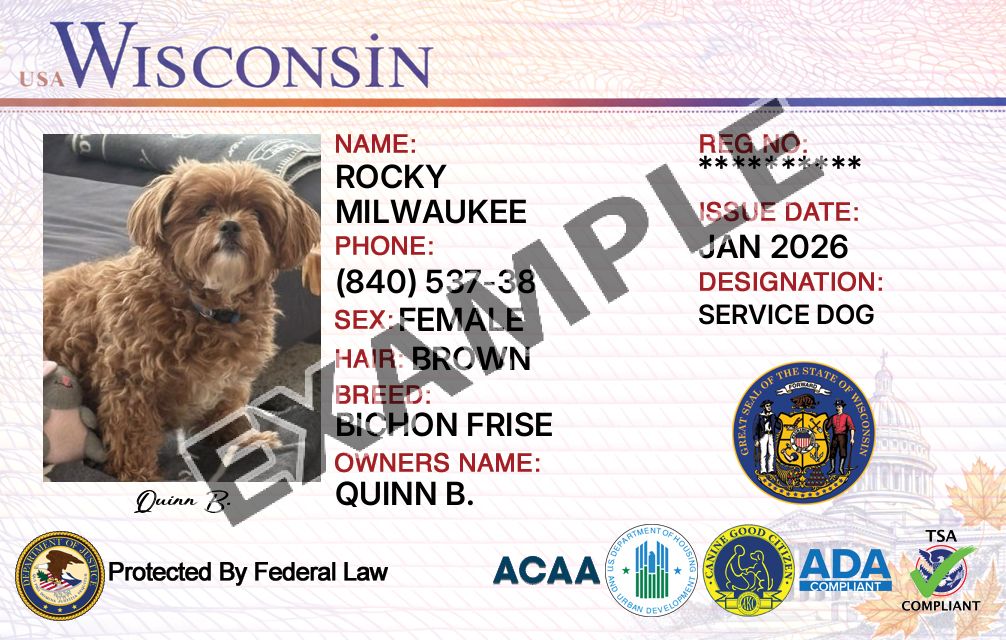
Service Dogs and Emotional Support Animals in Grant, Wisconsin
If you’re searching where do I register my dog in Grant County, Wisconsin for my service dog or emotional support dog, the answer is usually simpler than it sounds: you typically register (license) your dog through your local city, village, or town clerk/treasurer office—not through a special “service dog registry.”
This page explains how a dog license in Grant County, Wisconsin generally works, how rabies rules connect to licensing, and how licensing differs from the legal status of a service dog or an emotional support animal (ESA).
Where to Register or License Your Dog in Grant County, Wisconsin
Because licensing is often handled locally, below are example official offices within Grant County, Wisconsin that provide dog licensing or can direct you to the correct licensing contact for your address. If you live in a different municipality (city/village/town), your clerk/treasurer is often the right starting point.
City of Platteville — Finance Department (Dog Licensing)
Address:
75 N. Bonson Street
Platteville, WI 53818
Phone: (608) 348-9741
Office Hours:
Monday–Friday, 8:00 a.m.–4:30 p.m.
Notes: The City of Platteville states dog licenses are available through the Finance Department at City Hall and that dogs 5 months and older must be licensed in the city. (platteville.org)
City of Lancaster — City Hall
Address:
206 S Madison St
Lancaster, WI 53813
Main Phone: (608) 723-4246
Clerk/Treasurer Phone: (608) 723-7445
Email: davidk@lancasterwisconsin.com
Notes: Address and contact details are listed by City sources/official directories. (lancasterwisconsin.com)
City of Fennimore — City Clerk’s Office
Address:
860 Lincoln Ave
Fennimore, WI 53809
Phone: (608) 822-6119
Notes: The City of Fennimore lists the City Clerk’s office at this address and phone for ordinance information (commonly where licensing questions are routed). (fennimore.com)
Grant County, Wisconsin — County Government (General Directory)
Office: Grant County Government (Department directory)
Notes: The county site provides a department directory (useful if you need to locate county contacts related to ordinances or law enforcement). Local municipal clerks typically handle licensing. (gcinternetwebsite.co.grant.wi.gov)
Overview of Dog Licensing in Grant County, Wisconsin
What “registering your dog” usually means
In everyday terms, “registering” a dog typically means getting a local dog license. A license is usually renewed annually and is tied to a numbered tag that helps identify your dog if it gets lost and supports local animal control and rabies public-health enforcement.
Dogs are commonly licensed once they reach the minimum age
Wisconsin municipalities commonly require licensing for dogs once they are older than a minimum age threshold. For example, the City of Platteville states that dogs 5 months and older are required to be licensed in the city. (platteville.org)
Rabies vaccination is the key document behind licensing
Under Wisconsin’s rabies control law, dog owners must keep their dogs vaccinated against rabies on schedule, generally before the prior vaccination expires (often within 1-year or 3-year intervals depending on the vaccine and certificate). (law.justia.com)
Many licensing offices require proof of rabies vaccination (often a rabies certificate with vaccine details) before they can issue a license. For example, Platteville’s licensing page explains that owners should bring proof of rabies vaccination and notes that a typical vet bill may not include all required details. (platteville.org)
How Dog Licensing Works Locally in Grant County, Wisconsin
Step-by-step: where to register a dog in Grant County, Wisconsin
- Identify your municipality (City of Platteville, City of Lancaster, City of Fennimore, or a specific Town/Village in Grant County).
- Contact the local licensing office (often Finance Department, Clerk, or Clerk/Treasurer).
- Bring required documentation—most importantly rabies vaccination proof. (platteville.org)
- Pay the licensing fee (fees vary by municipality and may differ based on spay/neuter status).
- Receive the license tag and keep it attached to your dog’s collar as required by local rules.
Why it’s local (and why that matters)
When people search for an animal control dog license Grant County, Wisconsin, they’re often expecting a single countywide office. In practice, licensing is frequently handled by the city/village/town you live in. That means:
- The correct office can change based on your address (even within the same ZIP code).
- Deadlines, fees, and renewal methods can differ by municipality.
- If you move within Grant County, you may need to license your dog under your new local jurisdiction.
Example: what one Grant County city requires
The City of Platteville provides a clear example of local licensing rules: licenses are valid for the calendar year (January 1–December 31) and the city indicates dogs are to be licensed by a local deadline, with late fees after that date. (platteville.org)
Tip: If your dog is a service dog or an ESA, you still generally follow the same municipal dog licensing process as other dog owners. The “service” or “support” role usually does not replace the need for a local license.
Service Dog Laws in Grant County, Wisconsin
A service dog’s legal status is not created by a county registry
Under the Americans with Disabilities Act (ADA), a service animal is generally a dog that is individually trained to do work or perform tasks for a person with a disability. Businesses and other covered entities are not allowed to demand documentation or proof that the dog is registered, certified, or licensed as a service animal. (ada.gov)
What businesses are allowed to ask (and what they can’t ask)
The ADA guidance explains that staff may ask only certain limited questions when the need for a service animal isn’t obvious, and they generally may not request documentation or require the dog to demonstrate its task. (ada.gov)
How service dog rights relate to a dog license in Grant County, Wisconsin
A service dog can have public-access rights under the ADA while still being subject to local animal health and safety rules—like rabies vaccination requirements and local licensing. In other words, your service dog can be both:
- Legally a service animal for access purposes under federal law, and
- Required to have a local license based on where you live.
Avoid confusion with “online service dog registration”
If you’re trying to figure out where to register a dog in Grant County, Wisconsin, be cautious: many online “registrations” are not required for ADA service animal rights, and the U.S. Department of Justice does not treat those documents as proof under the ADA. (ada.gov)
Emotional Support Animal Rules in Grant County, Wisconsin
An ESA is different from a service dog
An emotional support animal (ESA) may provide comfort or support, but ESAs are not automatically treated the same as service dogs for public access under the ADA. This difference matters when you’re deciding what you actually need:
- Dog license: local registration for dogs (typically required for dogs over the local minimum age and linked to rabies vaccination).
- Service dog: a dog trained to perform tasks for a disability (public access under the ADA may apply). (ada.gov)
- ESA: generally a housing-related designation (depending on the housing situation and applicable laws/policies), not a general “take your dog everywhere” status.
Licensing and rabies rules still apply
Even if your dog is an ESA, local rules on rabies vaccination still apply. Wisconsin law requires rabies vaccination for dogs, and rabies-related requirements can also apply after bites (such as quarantine requirements). (law.justia.com)
Practical takeaway for ESA owners
If your main question is, “where do I register my dog in Grant County, Wisconsin,” the answer is usually: your municipal clerk/treasurer (or the city finance/clerk office). The ESA status does not replace the basic steps for obtaining a local dog license.
Frequently Asked Questions
Usually, yes. A service dog’s ADA status relates to access rights, while local licensing is a municipal requirement tied to rabies vaccination and identification. For example, Platteville states dogs 5 months and older must be licensed and requires proof of rabies vaccination to register. (platteville.org)
For ADA public-access purposes, the U.S. Department of Justice does not require service animals to be registered and does not recognize online “certificates” as proof. What you typically need locally is a standard dog license through your municipality (city/village/town) plus current rabies vaccination documentation. (ada.gov)
Licensing offices often ask for a rabies certificate (not just a receipt). The City of Platteville notes that a vet bill may not include all required details and suggests obtaining a copy of the rabies certificate to ensure you have the needed information. (platteville.org)
Wisconsin law requires owners to keep dogs vaccinated against rabies on schedule (typically before the prior vaccination expires). (law.justia.com)
Start with your municipality’s clerk/treasurer or city hall office. If you live in a city like Platteville, their Finance Department is identified as the dog licensing office. If you live in another city such as Lancaster or Fennimore, the city hall/clerk offices can usually direct you to the right licensing process for your specific location. (platteville.org)
Wisconsin guidance explains that dogs and cats that bite a person must be quarantined for observation for a set period, regardless of vaccination status. (datcp.wi.gov)
Overview of Dog Licensing in Grant County, Wisconsin (Local Focus)
Why municipalities issue many licenses
In much of Wisconsin, local municipalities manage dog licensing and keep local records that support lost-dog returns, enforcement, and public health coordination. That’s why your answer to where to register a dog in Grant County, Wisconsin depends on your city/village/town.
Rabies rules are statewide
While licensing offices are local, rabies vaccination requirements are statewide. Wisconsin law requires owners to keep dogs vaccinated against rabies, and bite incidents can trigger quarantine requirements. (law.justia.com)
Register A Dog In Other Wisconsin Counties
Select your county below to get started with your dog’s ID card. Requirements and license designs may vary by county, so choose your location to see the correct options and complete your pup’s registration.
- Adams County Dog Registration
- Ashland County Dog Registration
- Barron County Dog Registration
- Bayfield County Dog Registration
- Brown County Dog Registration
- Buffalo County Dog Registration
- Burnett County Dog Registration
- Calumet County Dog Registration
- Chippewa County Dog Registration
- Clark County Dog Registration
- Columbia County Dog Registration
- Crawford County Dog Registration
- Dane County Dog Registration
- Dodge County Dog Registration
- Door County Dog Registration
- Douglas County Dog Registration
- Dunn County Dog Registration
- Eau Claire County Dog Registration
- Florence County Dog Registration
- Fond du Lac County Dog Registration
- Forest County Dog Registration
- Green County Dog Registration
- Green Lake County Dog Registration
- Iowa County Dog Registration
- Iron County Dog Registration
- Jackson County Dog Registration
- Jefferson County Dog Registration
- Juneau County Dog Registration
- Kenosha County Dog Registration
- Kewaunee County Dog Registration
- La Crosse County Dog Registration
- Lafayette County Dog Registration
- Langlade County Dog Registration
- Lincoln County Dog Registration
- Manitowoc County Dog Registration
- Marathon County Dog Registration
- Marinette County Dog Registration
- Marquette County Dog Registration
- Menominee County Dog Registration
- Monroe County Dog Registration
- Oconto County Dog Registration
- Oneida County Dog Registration
- Outagamie County Dog Registration
- Ozaukee County Dog Registration
- Pepin County Dog Registration
- Pierce County Dog Registration
- Polk County Dog Registration
- Portage County Dog Registration
- Price County Dog Registration
- Racine County Dog Registration
- Richland County Dog Registration
- Rock County Dog Registration
- Rusk County Dog Registration
- Sauk County Dog Registration
- Sawyer County Dog Registration
- Shawano County Dog Registration
- Sheboygan County Dog Registration
- St. Croix County Dog Registration
- Taylor County Dog Registration
- Trempealeau County Dog Registration
- Vernon County Dog Registration
- Vilas County Dog Registration
- Walworth County Dog Registration
- Washburn County Dog Registration
- Washington County Dog Registration
- Waukesha County Dog Registration
- Waupaca County Dog Registration
- Waushara County Dog Registration
- Winnebago County Dog Registration
- Wood County Dog Registration